

Weather Map for Venice, CA — via Weather Underground (http://bit.ly/WUmshare).
View on the web: http://www.wunderground.com/cgi-bin/findweather/getForecast?query=33.992838,-118.469407
Weather Map for Venice, CA — via Weather Underground (http://bit.ly/WUmshare).
View on the web: http://www.wunderground.com/cgi-bin/findweather/getForecast?query=33.992838,-118.469407
At roughly $1,165 a square foot, the transaction is one of the priciest ever per square foot for a large office complex in Los Angeles.
http://www.labusinessjournal.com/news/2016/nov/18/oracle-buys-santa-monica-offices-368-million/
So, the Backbone scene isn’t what it used to be. But, I recently implemented a Backbone solution with RequireJS. I really like having the ability to “lazy load” resources on demand.
Anyone who has worked with Backbone’s router knows that your code can get quite lengthy when the number of routes starts to grow. The example below shows a simple router with three routes. But what if you have ten? What then?
// Backbone's sample router
var Workspace = Backbone.Router.extend({

  routes: {
    "help":                 "help",    // #help
    "search/:query":        "search",  // #search/kiwis
    "search/:query/p:page": "search"   // #search/kiwis/p7
  },

  help: function() {
    ...
  },

  search: function(query, page) {
    ...
  }

});
I started out by placing the actual routes in a separate file that I could read in to my router.js file. I created a new file for the routes and moved them in there. I added the JSON and Text plugins for RequireJS so I could load the data from the routes.json file.
I used the routes to create a new instance of a Backbone Router.
var AppRouter = Backbone.Router.extend({ routes: routes });
Since I already had the routes as a JavaScript object, I used them to create a single-dimension array.
var appRouter = new AppRouter();
var views = Object.keys(appRouter.routes).map(function (c) {
 return c;
});
I also made sure that each route had the same name as its respective view-controller. So, the route to help should load a file named help.js.
Then, I simply needed to iterate over the array of routes, defining routing event handlers for each one. I embed a require function call that loads the respective view-controller, passing it in to the callback function.
Once inside the function, I instantiate the Backbone View class and call its render function.
views.forEach(function(view) {
    appRouter.on('route:' + view, function() {
        require(['views/' + view], function (ViewClass) {
            var viewInstance = new ViewClass();
            viewInstance.render();
        });
    });
});
Et voila!
One caveat: loading Backbone views asynchronously can cause events to re-bind when the view is loaded again. This can lead to weird UI side-effects, like “ghost” or “zombie view” problems. Derick Bailey discusses how to resolve such issue in his Los Techies article.

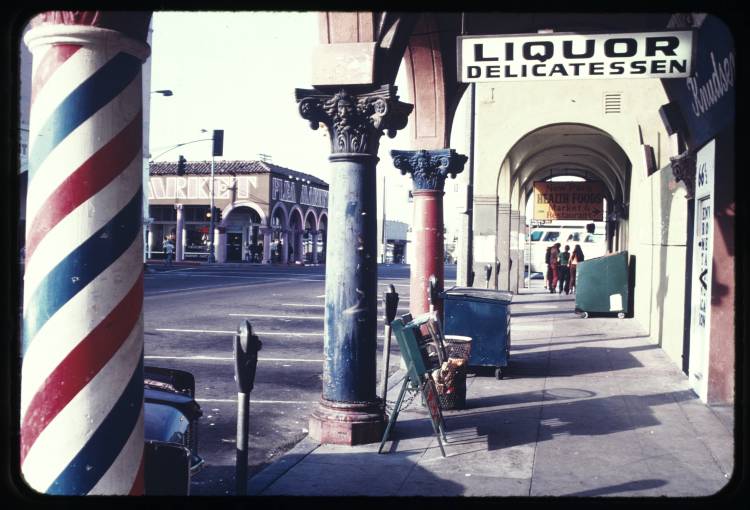
Searching the USC digital archives for photos of Venice, I found this in the collection called “Robin Dunitz Slides of Los Angeles Murals, 1925-2002.”
It’s a great view from in front of what’s now Menotti’s Cafe on Windward. Based on the striped column, it looks like there was once a barber shop there.
What’s now Collage Cafe once had a sign labelled “Flea Market.” I remember when Bank of Venice was a Coffee Bean and Tea Leaf. It’s hard to believe that back then it was a health food store.
Finally!!! Some good news!
The husband-and-wife duo, who played themselves on Larry David’s long-running HBO series, will join the series’ core cast — David, Jeff Garlin, Cheryl Hines and Susie Essman — who are all set to come back when the show makes it comeback.
In other news, there will be a ninth season of Curb Your Enthusiasm!
I haven’t felt this good since … since … well, it’s been a while.
Source: ‘Curb Your Enthusiasm’ Season 9 Cast: Ted Danson, Mary Steenburgen Return | Hollywood Reporter

 QuantumTom