
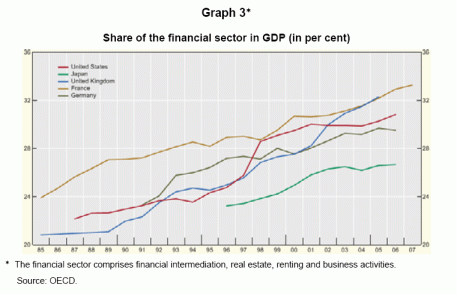
I’m not certain why, but I was earlier reminded of a recent statement illustrating the rate at which Financial Services, as a component of US GDP, had grown dramatically in the post-Cold War period. I was startled by the figures I’d heard, but only this evening took it upon myself to actually research the claim.
The figures I discovered which best suited my inquiry are sourced to the Bank of International Settlements in Basil. Some of you may know this institute as the clearinghouse that allowed German and American financiers and industrialists to have financial interactions during World War II (AGFA, BASF, Bayer, I.G. Farbenindustrie, ITT, Deutsche Telekom, GM, IBM, GE, DuPont, Standard Oil, Coca Cola, Dow Chemical, it’s really silly how long the list gets). The bank was appropriately enough co-founded by Germany’s finance minister, and two-time appointee to head the Reichsbank, Hjalmar Schacht, who had, oddly enough, a rather American sounding full name: Horace Greeley Hjalmar Schacht.
He had this name because, although born in Germany, Schacht had grown up in New York.
I sort of remember reading somewhere that Schacht had once had some sort of minor social interaction once with FDR at the Harvard Club in New York. This all happened before FDR had fully entered politics.
The BIS was so publicly scandalous that in 1944, an organization no less august the the United Nations recommended its dissolution. See United Nations Monetary and Financial Conference, Final Act (London et al., 1944), Article IV. Obviously this action was never undertaken.
Nevertheless, I digress. You can see the charts and figures at the BIS website. It’s all very interesting if you like that sort of thing.
It’s crazy when you read up on it and you realize, on a strategic level, what significance there was in the role of economics in World War II, particularly in the European theater. I suppose you can have a global total war between industrialized nations without a large amount of capital interactions between the opposing sides. This is particularly obvious in consideration of the entanglements resulting from Versailles.
 QuantumTom